
 Hot Topic
 Market News
 Events & Promo
 Career Tips
 Education News
 Health & Life








Asia is rewriting mental health — and the West may not be ready for what comes next
TAIPEI and NEW YORK, March 26, 2026 /PRNewswire/ -- In America, Chinese Communities Are Quietly Rewriting the Rules of Mental Health
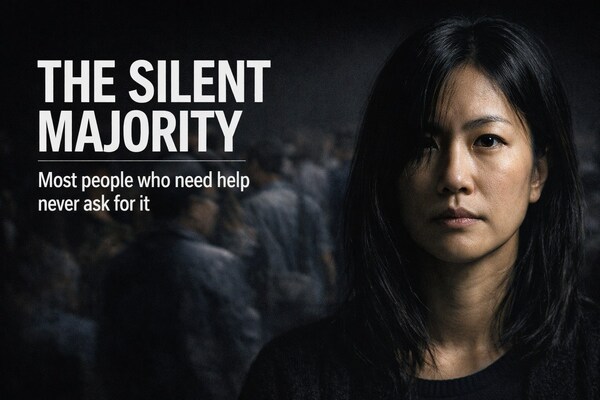
Chinese Online Therapist
For decades, the global mental health system has been shaped by a Western logic: diagnose, treat, and measure.
It is a system built on articulation — on the belief that people will name what they feel, and seek help accordingly.
That assumption is beginning to fracture.
Across Asian societies and diaspora communities, particularly among Chinese populations in the United States, a different pattern is emerging. Engagement does not begin with diagnosis. It does not always begin with therapy. In many cases, it does not begin at all — at least not in ways traditional systems recognize.
Because a quieter reality has always existed beneath the surface:
The majority of people who need help never ask for it.
The Gap No System Has Solved
According to the World Health Organization, roughly one in eight people worldwide lives with a mental health condition. Yet treatment gaps remain substantial, exceeding 70% in many regions.
Even where services are available, utilization remains uneven. Among minority communities in developed countries, the gap is often wider.
For Chinese and broader Asian populations, the barriers are not only structural, but cultural. Emotional restraint is often embedded in social norms. Disclosure is not always neutral. Seeking help can carry implications beyond the individual — extending to family, identity, and social cohesion.
As a result, demand does not disappear.
It becomes invisible.
A System Built for Those Who Speak
Modern mental health infrastructure was designed to expand access — more providers, more coverage, more awareness.
But access does not guarantee engagement.
Research published in The Lancet Psychiatry and JAMA Network Open has consistently shown that stigma, cost, and cultural mismatch continue to suppress help-seeking behavior, even in high-income settings.
Employee Assistance Programs, widely adopted across corporations, often report utilization rates below 10%.
The system has scaled.
The behavior has not.
The mismatch is no longer marginal.
It is structural.
Asia Is Not Scaling the Model — It Is Changing the Entry Point
Across Asia, a different approach is taking shape — not through policy, but through adaptation to how people actually behave.
Instead of waiting for individuals to enter formal care, these models focus on reducing the psychological threshold required to begin:
Digital platforms have accelerated this shift, embedding mental health into everyday contexts rather than isolating it within clinical environments.
A Quiet Redesign, Built on Constraint
In Taiwan, platforms such as HealYou (聊心茶室) have developed cross-border mental health networks that connect users with licensed professionals, while adapting services to linguistic and cultural realities.
They operate within one of Asia's more tightly regulated professional environments, where psychologists are required to complete formal clinical training and national certification. The regulatory structure imposes a level of rigor that shapes both supply and trust.
At the same time, the platform is built primarily around Traditional Chinese — a linguistic system that demands not only fluency, but precision in meaning, tone, and cultural reference across different Chinese-speaking communities.
Within that constraint lies its design logic:
If people will not enter the system as it exists, the system must change how it meets them.
Not at the point of crisis.
But earlier — where hesitation still outweighs resistance.
The Market No One Sees
The global mental health market is projected to expand significantly in the coming decade.
But most forecasts are based on a familiar premise: that more people will enter existing systems.
The more consequential question may be different:
What about those who never will?
Asia, which represents more than half of the world's population, remains unevenly served by culturally aligned mental health infrastructure. At the same time, high digital adoption and shifting generational attitudes are enabling new forms of engagement.
This creates a paradox.
The regions with the lowest historical participation may become the fastest-growing — not because they are catching up, but because they are building from different assumptions.
What Comes Next
If the last century defined mental health through clinical authority, and the last decade expanded access through technology, the next phase may be defined by something less visible:
Alignment.
Not every system scales globally.
But systems that align with behavior often scale faster.
The question is no longer whether mental health will grow.
It already is.
The question is who defines how it works.
And increasingly, that answer may not come from where the model was first built —
but from where it never fully applied.
CONTACT: Jessie Chang, support@healyou.io


 11 days ago 11 days ago
  14 days ago
  14 days ago
14 days ago
14 days ago  14 days ago
  14 days ago
 14 days ago 14 days ago 14 days ago 14 days ago 14 days ago 14 days ago 14 days ago
14 days ago
14 days ago 14 days ago 14 days ago 14 days ago 14 days ago 14 days ago 14 days ago 14 days ago  14 days ago
14 days ago 14 days ago
14 days ago
14 days ago
14 days ago 14 days ago



 Contact Us
 Notice
 Back to Top


 中文
中文